'Brain Rot' Is Trending, But Brain Fog Is the Real Story — Here's What Lion's Mane Actually Does

TL;DR
- "Brain rot" is a slang label (Oxford's 2024 Word of the Year) for the mental sludge people associate with endless scrolling. Brain fog is the older, broader term for real subjective symptoms — slow recall, poor focus, mental fatigue.
- Brain fog is usually multifactorial — sleep debt, chronic stress, ultra-processed diet, blood-glucose volatility, dehydration, screen overuse, low-grade inflammation, and post-viral or hormonal factors all contribute.
- Lion's mane (Hericium erinaceus) is the most researched nootropic mushroom. Small clinical trials suggest cognitive and mood-related benefits over 8–16 weeks at doses of roughly 0.5–3 g/day.
- Reishi (Ganoderma lucidum) is studied for sleep quality and fatigue. Phosphatidylserine has decades of research for age-related memory concerns and stress-cortisol reactivity.
- Supplements do not fix chronic sleep debt or unmanaged screen habits. They are additive tools on top of the boring stuff that actually works.
- See a healthcare provider if brain fog is severe, persistent, or accompanied by other neurological, thyroid, or mood symptoms.
If you have spent five minutes on TikTok in the last year, you have seen "brain rot." Oxford University Press named it the 2024 Word of the Year — a term describing what people feel their attention span becomes after enough hours of doomscrolling, doomscrolling adjacent content, and reels of other people doomscrolling.
But strip away the slang, and there is a much older, more useful term underneath it: brain fog. Ask any twenty-something who used to be sharp at work and now cannot hold a name in their head for four seconds, or any grad student who reads the same paragraph three times before it registers. Brain fog is the felt symptom. Brain rot is the meme.
Search interest in "brain fog," "lion's mane benefits," "how to fix brain fog," and "best supplements for focus" has been climbing on Google Trends for several years — with a step-change after 2020 when post-viral cognitive symptoms went mainstream. On TikTok, #lionsmane and #brainfog together have hundreds of millions of views, and Pinterest wellness boards have quietly turned "nootropic mushrooms" into a category the way collagen became one a decade ago.
This piece is written the way I would want it written for me — mechanism first, hype last. What is brain fog, what does the research say about lion's mane and other adaptogenic mushrooms, and where do supplements actually fit in a routine that also includes sleep, sunlight, screen habits, and lifting heavy things?
What Is Brain Fog, Really?
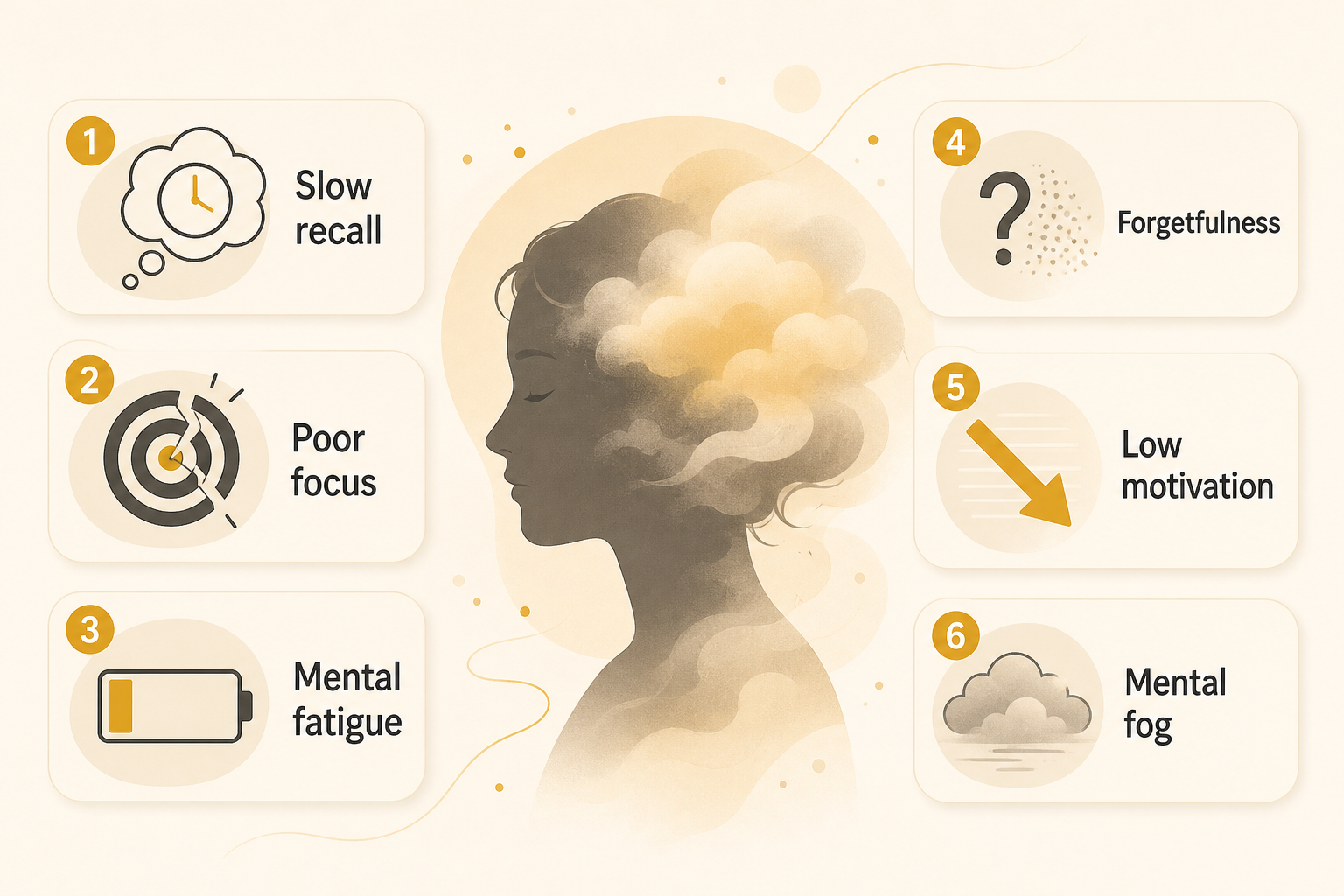
Brain fog is not a formal diagnosis. You will not find an ICD-10 code for it. It is a descriptive term for a cluster of subjective symptoms:
- Slow word retrieval and "tip of the tongue" moments
- Difficulty focusing on one task for more than a few minutes
- Mental fatigue disproportionate to physical exertion
- Reduced working memory (forgetting why you walked into a room)
- Slower processing speed on tasks that used to feel automatic
- Low motivation or a "just do it later" bias that outlasts the mood
Brain fog shows up in the clinical literature as a described feature of many conditions — post-viral syndromes, sleep disorders, thyroid dysfunction, iron deficiency, chronic pain, perimenopause, autoimmune disease, chemotherapy recovery, and simple burnout. Ocon (2013), writing in Frontiers in Physiology, described brain fog in ME/CFS and postural tachycardia patients as involving reduced cognitive efficiency, poor concentration, and cognitive fatigue disproportionate to workload — a description many people without those diagnoses would recognize.
For the healthy young adult searching "how to fix brain fog," the honest picture is usually less dramatic and more cumulative:
- Chronic sleep debt. Van Dongen et al. (Sleep, 2003) showed that after two weeks of six-hour nights, participants performed as poorly on attention tasks as those who had been awake for 48 hours straight — while subjectively feeling "fine."
- Blood glucose volatility from ultra-processed carbs on an empty stomach is associated with post-prandial energy crashes and reduced cognitive performance.
- Chronic low-grade inflammation and cytokine signaling is one of the more actively studied mechanisms behind post-viral cognitive symptoms (Yirmiya & Goshen, Brain Behav Immun, 2011).
- Screen exposure and dopaminergic overload. Short, high-novelty content trains the attentional system toward rapid task-switching — a plasticity outcome that can leave sustained-focus tasks feeling harder.
- Hydration, iron, B12, thyroid, and hormonal factors are routinely under-checked in people who assume they are "just tired."
Which is a long way of saying: brain fog is real, it is usually multifactorial, and no single supplement is going to erase it. But some ingredients are more interesting than others — and that is where mushrooms come in.
Why Did Lion's Mane Become the Trending "Brain Rot Fix"?

Lion's mane (Hericium erinaceus) is the shaggy, white, coral-looking mushroom that has quietly taken over the nootropic conversation. It has grown into a category the way ashwagandha did — from a niche traditional-medicine ingredient to a mainstream, TikTok-explainable supplement.
There are three reasons it caught on. First, it has real mechanistic research — not just marketing. Second, two compound families in the mushroom, hericenones (from the fruiting body) and erinacines (from the mycelium), have been shown in cell and animal models to stimulate nerve growth factor (NGF) synthesis (Kawagishi et al., Tetrahedron Letters, 1991; Mori et al., Biol Pharm Bull, 2008). Third, there are actually small human trials. That is rare for a supplement in this category.
What Do Human Trials Actually Show for Lion's Mane?
The honest answer is: promising, small, and heterogeneous. Not "cure your brain fog in 30 days." Here is what we have:
- Mori et al., Phytotherapy Research, 2009 — 30 Japanese adults aged 50–80 with mild cognitive impairment took 3 g/day of lion's mane for 16 weeks. Cognitive scores on the Revised Hasegawa Dementia Scale improved significantly versus placebo. Improvements diminished 4 weeks after supplementation was stopped.
- Saitsu et al., Biomedical Research, 2019 — A double-blind RCT in 31 Japanese adults given lion's mane fruiting body extract for 12 weeks. Visual and short-term memory scores improved versus placebo.
- Docherty et al., Nutrients, 2023 — 41 young, healthy adults. A single 1.8 g dose improved Stroop task performance at 60 minutes. Over 28 days, subjective stress was reduced compared to placebo.
- Vigna et al., Evid Based Complement Alternat Med, 2019 (PMC6982118) — 77 overweight/obese adults given 80 mg/day of lion's mane extract for 8 weeks reported reductions in depression, anxiety, and sleep disturbance scores.
Compared to most supplement categories, that is a relatively coherent story: several small trials leaning in the same direction — improvements in subjective cognition, mood, and stress across doses of roughly 0.5–3 g/day over 4–16 weeks.
What we cannot honestly say: lion's mane "regrows your brain," "cures ADHD," or delivers cinematic focus in 20 minutes. The healthy way to read the evidence is plausible, promising, and worth studying more — not proven for every claim you see in a 15-second video.
What About "NGF" and "Neurogenesis" Claims?
This is where the science and the influencer script diverge fastest. In vitro and rodent studies show that hericenones and erinacines can stimulate NGF synthesis in nerve cells and support myelination-relevant processes (Kolotushkina et al., 2003; Lai et al., Int J Med Mushrooms, 2013). We do not yet have strong direct human evidence that oral lion's mane meaningfully increases NGF in the human brain — the blood-brain barrier, bioavailability of erinacines vs. hericenones, and dosing are all open questions. So when a video claims lion's mane "boosts NGF and grows new brain cells," the accurate version is: compounds in lion's mane stimulate NGF in laboratory models; whether that translates to measurable NGF changes in the human brain at supplement doses is still being investigated.
The Full Ingredient Stack: Lion's Mane, Reishi, and Phosphatidylserine
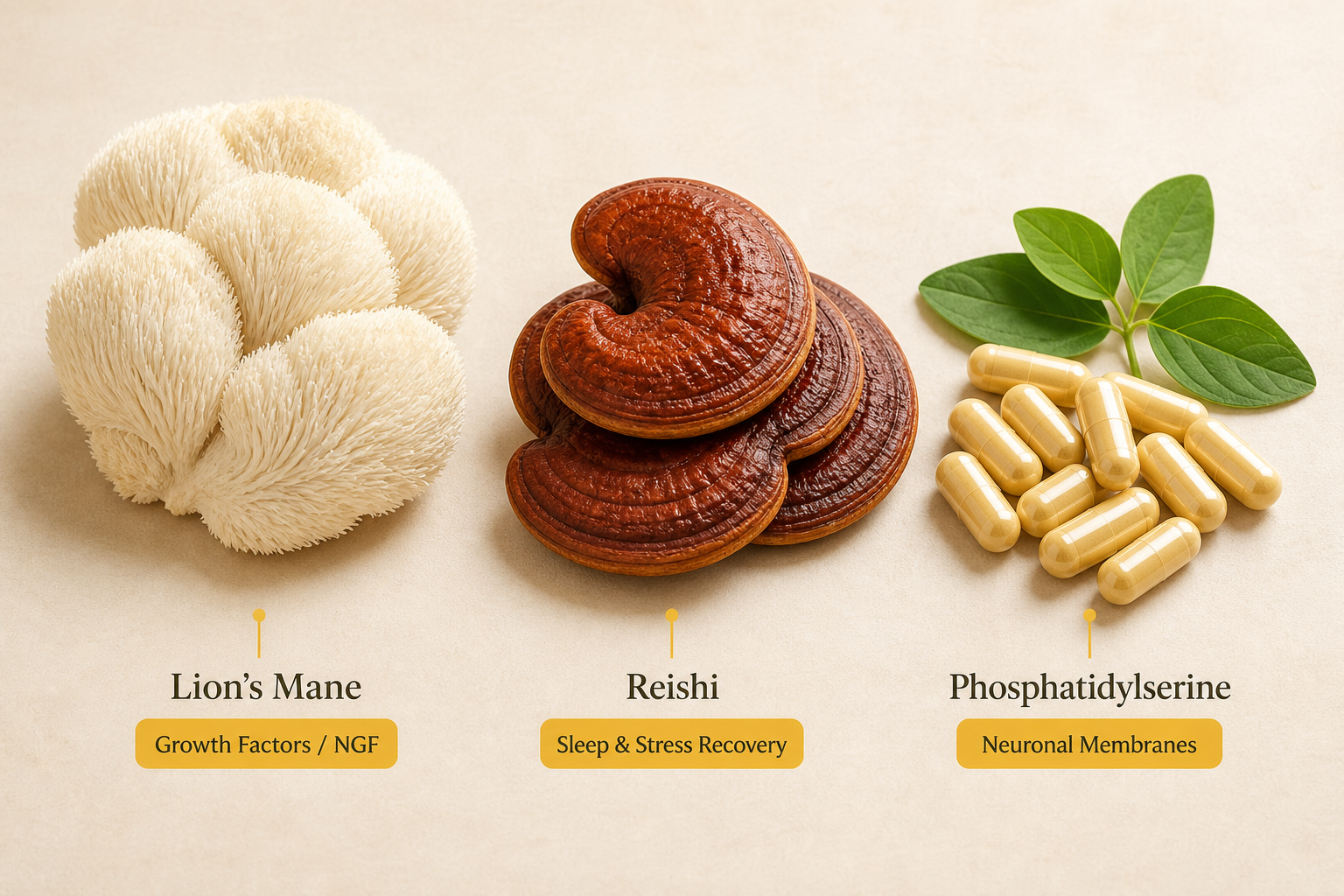
Modern focus formulas usually do not lean on lion's mane alone. The more thoughtful ones pair it with reishi and phosphatidylserine to target focus from more than one angle.
Reishi (Ganoderma lucidum): The Sleep-Stress Layer
If lion's mane is the "focus" mushroom, reishi is the "regulate the nervous system so focus is even possible" mushroom. Reishi is rich in triterpenoids (ganoderic acids) and beta-glucans, and is investigated for immune modulation, anti-fatigue effects, and sleep quality. Cui et al. (J Ethnopharmacol, 2012) showed in a rodent model that reishi extract shortened sleep latency and increased non-REM sleep. A 2005 human study by Tang et al. in patients with neurasthenia reported improvements in fatigue and sense of well-being over 8 weeks of reishi supplementation.
Most people who complain about brain fog are chronically under-slept and over-stimulated. Reishi's proposed role is not to make you more alert acutely — that is caffeine's job — but to support the recovery layer that lets focus return the next day.
Phosphatidylserine (PS): The Neuronal Membrane Layer
Phosphatidylserine is a phospholipid enriched in the inner leaflet of neuronal cell membranes. It has one of the older evidence bases in the cognitive supplement category. Kato-Kataoka et al. (J Clin Biochem Nutr, 2010) tested 300 mg/day of soy-derived PS versus placebo for 6 months in 78 elderly participants with cognitive complaints. The PS group showed improvements in memory function scores. Hellhammer et al. (Stress, 2004) and Monteleone et al. (1992) suggest PS may blunt the cortisol response to acute physical or psychosocial stress in some subjects.
The FDA has permitted qualified health claims for PS related to reducing the risk of cognitive dysfunction and dementia in the elderly — with the important caveat that the evidence is limited and inconclusive. That is stronger regulatory framing than most supplement ingredients get.
What Actually Fixes Brain Fog More Than Any Supplement
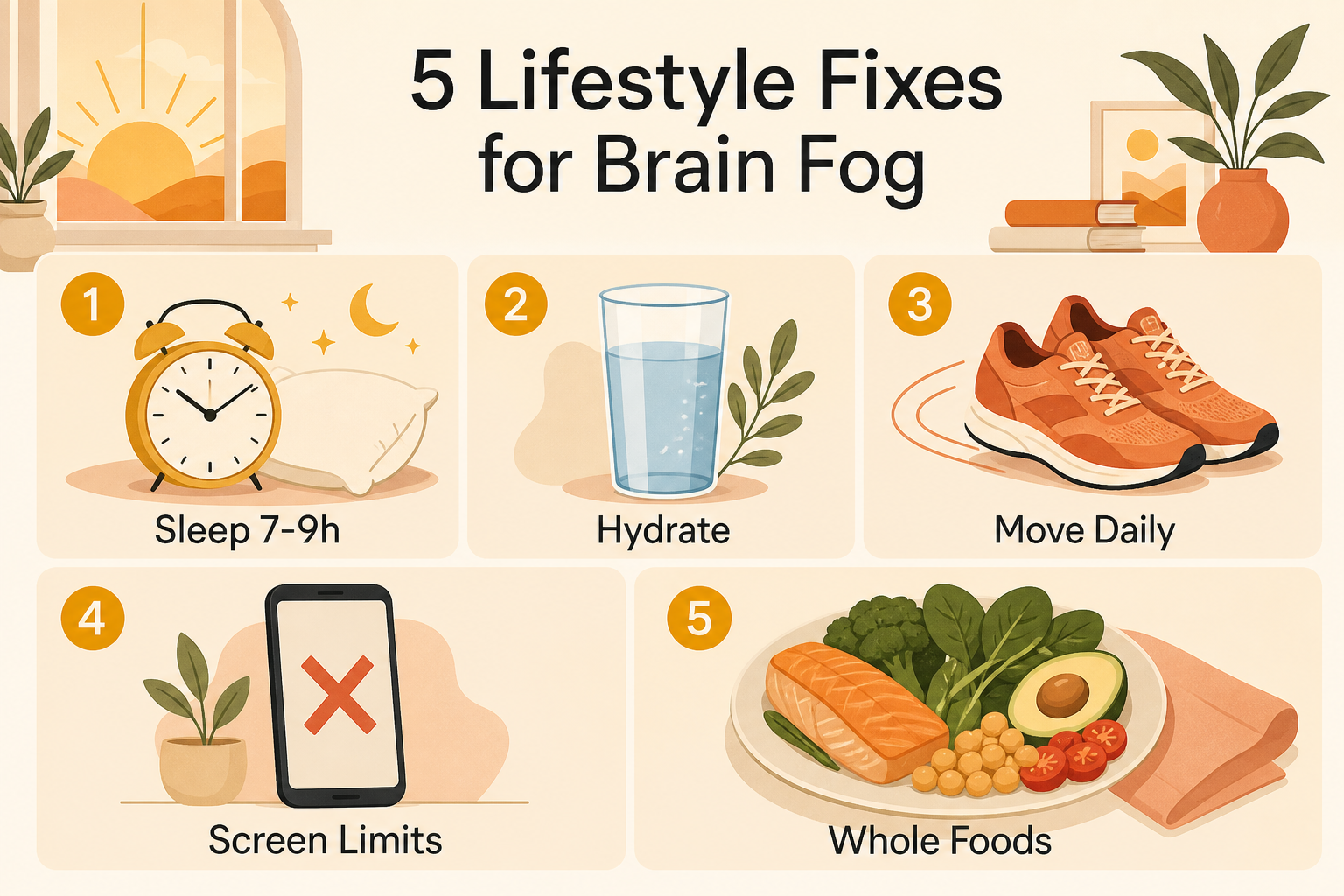
Any honest supplement article has to say this out loud: the lifestyle stack does the heavy lifting.
- Sleep is the biggest lever. Seven to nine hours of actual sleep — not "time in bed with your phone in your hand." If you are averaging 5–6, no mushroom is going to fix that.
- Move your body every day. Aerobic exercise is one of the few interventions with consistent evidence for increasing BDNF in humans (Szuhany, Bugatti & Otto, J Psychiatr Res, 2015).
- Stabilize your blood glucose. Prioritize protein and fiber at breakfast.
- Manage screen inputs like nutrients. Build in periods of long-form reading and focused work blocks to restore attentional stamina.
- Get sunlight in the morning for circadian regulation.
- Get your labs checked — thyroid, iron/ferritin, B12, vitamin D, HbA1c — if brain fog is severe or persistent.
Who Should (and Should Not) Consider a Focus / Memory Mushroom Supplement?
You might be a reasonable candidate if you are otherwise healthy, sleeping decently, and looking for an evidence-informed adjunct to a real cognitive routine — especially during high-demand work or study seasons.
Talk to a healthcare provider first if you have persistent, worsening, or sudden cognitive symptoms; a diagnosed thyroid, neurological, autoimmune, or mood disorder; are pregnant, nursing, or trying to conceive; take anticoagulants, antiplatelet, or immunosuppressive medications; or have known mushroom allergies.
Where M Nutrition Memory Mushroom Fits In
Our Memory Mushroom blend was designed for exactly the reader this article was written for — someone dealing with modern brain fog, curious about the lion's mane trend, and looking for a daily formula that includes the ingredient categories the research actually points to rather than a stack of buzzwords.
Each serving features a premium mushroom complex including lion's mane (Hericium erinaceus) and reishi (Ganoderma lucidum) — the two mushrooms with the deepest cognitive and stress-recovery research bases — combined with phosphatidylserine, one of the few cognitive-supplement ingredients with an FDA-permitted qualified health claim. That combination is designed to hit three complementary pathways in a single daily capsule:
- Lion's mane — proposed support for the growth-factor / neuroplasticity layer (Mori 2009; Saitsu 2019; Docherty 2023).
- Reishi — proposed support for the stress-recovery and sleep-quality layer (Cui 2012; Tang 2005).
- Phosphatidylserine — support at the neuronal-membrane and cortisol-response layer (Kato-Kataoka 2010; Hellhammer 2004).
It is not a nootropic that makes you feel a "hit" — that is not what this category is for. It is a daily formulation designed to sit alongside the boring, essential fundamentals of sleep, movement, sunlight, hydration, and reasonable screen limits — as a supplement, not a substitute.
Shop Memory Mushroom on Amazon
The Takeaway
"Brain rot" is a meme. Brain fog is real — and the reasons people are Googling how to fix it are legitimate, multifactorial, and worth taking seriously. The research on lion's mane is small, promising, and specifically most encouraging for daily cognitive support over 8–16 weeks — not for cinematic focus in one afternoon. Reishi offers a complementary sleep-and-stress angle. Phosphatidylserine hits the neuronal-membrane layer with one of the older evidence bases in the cognitive-supplement world. Close a few of the tabs, take care of the operating system, and — if you want — add a well-formulated supplement to the routine.